Boeing/Vertol
Labrador
(CH-113 / CH-113A)
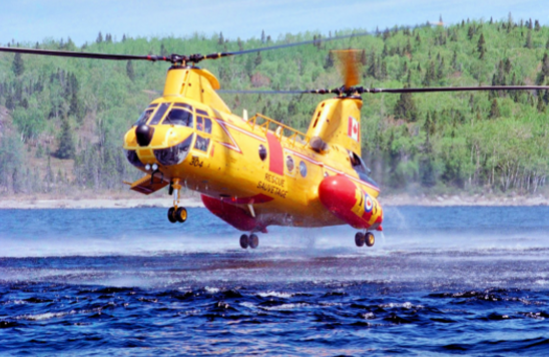
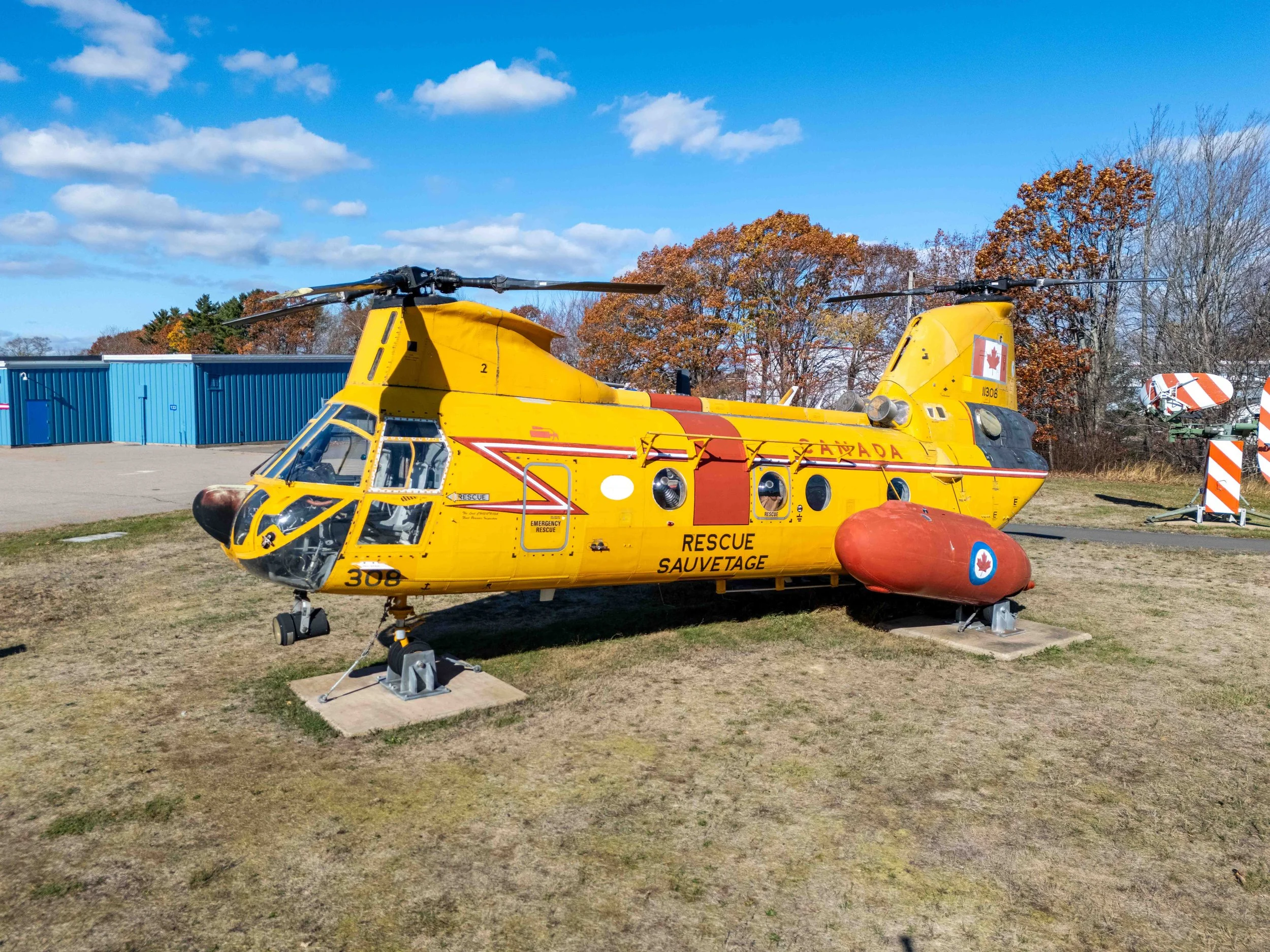
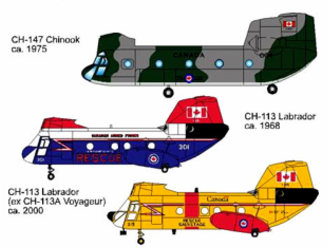
The Labrador aircraft is a twin-engine, tandem-rotor search and rescue (SAR) helicopter used by the Canadian Forces from 1963 until 2004. A variant of the Boeing -Vertol CH-46 Sea Knight, it was designed and built in the United States. Six search and rescue versions, manufactured in 1963 by the Boeing-Vertol division in Morton, Pennsylvania, were purchased by the Royal Canadian Air Force (RCAF) and known as the CH-113 Labrador (Lab). The Canadian Army acquired 12 of the similar CH-113A Voyageurs for the medium-lift transport role, but when the larger CH-147 Chinooks were procured in the mid-1970s, the Voyageur fleet was transferred to the SAR role providing 15 SAR aircraft across Canada divided into 4 units: 442 Sqn Comox, BC; 424 Sqn Trenton, ON; 413 Sqn Summerside, PEI (Greenwood, NS when 413 was moved) and 103 RU/Sqn Gander, NF.
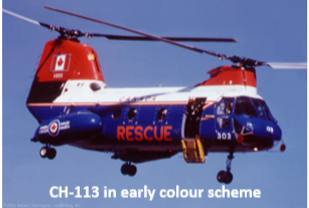
The tandem, counter-rotating, three-bladed rotors were powered by two GE T58 turboshaft engines, mounted in the rear fuselage and connected by two drive-shafts to a combining gear-box attached to the aft transmission. Power to the forward transmission was achieved through five sync-shafts. With three fixed tricycle landing gear and twin wheels on all three, the air-craft had a nose-up stance to facilitate cargo handling. Sponsons housed the main gear, 350 US gals (1,438 litres) of fuel and fuel dump tubes. A mid-life upgrade, SAR-CUP (Search and Rescue Capability Upgrade Program), in 1981 included new instrumentation, a nose-mounted weather radar, a tail-mounted auxiliary power unit, a new high-speed rescue hoist (300 feet per min and 600 lbs limit) mounted over the RH side door, front-mounted searchlights, a loud- hailer system, hydraulic rear ramp actuators, and long-range fuel tank sponsons. A total of six CH-113s and five CH-113As were upgraded, with the last delivered in 1984 and all called by the CH-113 Labrador name.
The Labrador had a watertight hull for marine landings and a water dam could be installed forward of the rear loading ramp for water deploying a zodiac or swimmers. An internal winch mounted in the forward cabin was used to assist pulling in cargo and was used as a backup rescue hoist via pulleys in the event of a main external hoist failure. The first Labrador (301) was delivered in 1963 to 102 Rescue Unit (RU) Trenton, ON (later 424 Sqn) and the last to serve (2004); 103 RU Gander, NF flew these aircraft from 1977 to 2003, 442 Sqn Comox, BC from 1968 to 2002, and 413 Sqn Summerside, PEI from 1968 to 1991 and Greenwood, NS from 1991 to 2002. 413 Sqn flew the Labrador until it was replaced in 2002 by the larger Cormorant. During the Squadron's stay in Greenwood, Labrador 305 crashed in Marsoui, QC.
On 2 Oct 1998 returning from a SAR mission. All six on board were killed. A memorial to the crew is contained in the Museum's Commemorative Gardens.
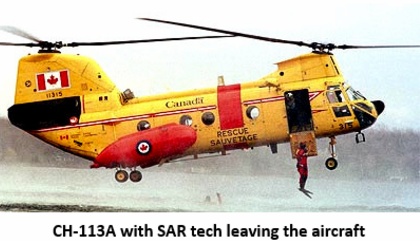
CH-113A with SAR tech leaving aircraft
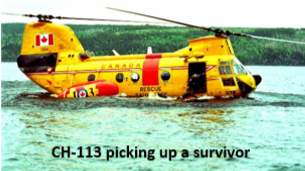
CH-113A with SAR picking up a survivor
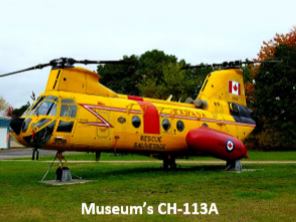
CH-113A in airpark
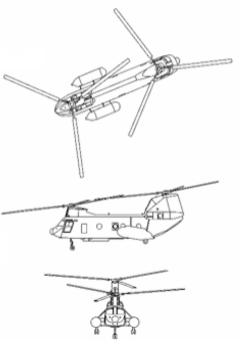
CH-113A overview
Aircraft Specifications
Role: Search and Rescue
Number built for Canada: 18
Manufacturer: Boeing-Vertol
Crew: 3 (flying) Pilot, Co-Pilot, Flight Engineer (SAR technicians) as required - 18 total max on board
Powerplants: two T58-100 turboshaft of 1,500 shp (1103 kw)
Maximum speed: 168 miles per hour (146 kts/270 kilometres per hour)
Cruising speed: 160 miles per hour (140 kts/257 kilometres per hour)
Service ceiling: 14,000 feet (4,265 meters)
Range: 1,110 kilometres (684 miles)
Empty Weight: 11,251 pounds (5,104 kilograms)
Max Weight: 21,400 pounds (9,706 kilograms)
Rotor Diameter: 50 feet (15.2 meters)
Length: 83 feet 4 inches (25.4 metres)
Height: 16 feet 8 inches (5.1 metres)