
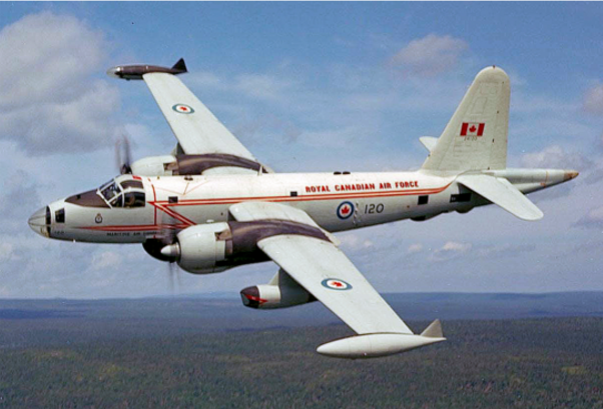
Lockheed Neptune
(P2V-7)
In 1952, the RCAF issued a requirement for an aircraft to replace the aging fleet of Lancaster search and patrol aircraft. Eventually realizing that the Lancaster could not continue to the expected date of its replacement - the Argus - the Air Force ordered the stock Lockheed P2V-7 Neptune as an interim replacement. An excellent choice, this aircraft was developed specifically for Anti-Submarine Warfare (ASW), and the Cold War was escalating with major incursions of Soviet surface and sub-surface combatants into the western Atlantic Ocean. Together with NATO air, surface and sub-surface resources, Canadian aircraft tracked these intruders and were prepared to sink them immediately if the rules of engagement changed and war was declared. Missions in Canada's north had the Neptune collecting data and doing photo reconnaissance of vast desolate areas. The aircraft was used because of its long range and stability, as well as its rugged dependability in severe climates.
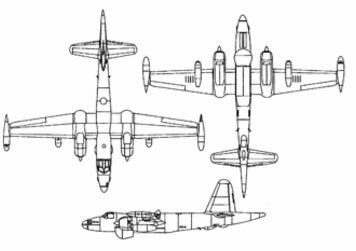
Minimum crew complement was 2 Pilots and a Flight Engineer (FE); on routine transits, the Radio, Radar and Navigation positions also were manned. Standard tactical crew was 10, due to the number of approved takeoff/crash positions. On routine transits, the Radio, Radar and Navigation positions were manned. In tactical situations, Nose Observer, Acoustics/Magnetic Anomaly Detection (MAD), Electronic Support Measures (ESM), and ASW were added. The latter position, at the rear of the aircraft, housed sonobuoys, charges, and smokes that were dropped to locate and mark contacts. Because Radio Operators were responsible for all positions except Pilot, FE and Navigator, they were the "Jack-of-all trades" type crew member. As the Neptune was a mid-wing aircraft, crew had to slide over the wing spar on their bellies to get from front to back and vice versa. Because of the 8,000 lb heavier approved takeoff weight with jets, the jets were always used at full power for takeoff; the extra thrust was necessary to get off the ground in a reasonable distance and to climb away if a reciprocating engine failed. As a fitting tribute to a grand "old lady" of the air, flown in a variety of operations by so many different nations, the P-2000 club (later VPI) was formed by 407 Commanding Officer, Herb Smale, in 1966. The common bond of having accumulated 2,000 flying hours in the P-2 Neptune was a noteworthy achievement that created friendships around the world; today called VPI, Maritime Patrol International, boasts membership of some 5,000 aviators worldwide.
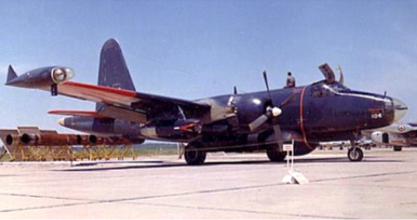
Initially, all Neptune's had a midnight-blue paint scheme; this was changed several years later to a standard RCAF blue-grey and white scheme. The first operational squadrons equipped with the Neptune were 404 and 405 in 1955, based in Greenwood, Nova Scotia; 415 in Summerside, PEI and 407 in Comox, BC received the aircraft later. The last aircraft flew in 1968. Although delivered without jet engines, retro-fitting began in 1959 to raise the all-up-weight from 72,000 to 80,000 lbs. The gain in pay-load was small because the jet s weighed about 6,000 lbs and the aircraft had to carry extra fuel to compensate for the extra weight and drag of the jet pods, but the aircraft was marginally safer on take-off with four engines. Single engine performance without jets was barely adequate but, in an emergency, weight could be reduced by about 3000 pounds by jettisoning full tip tanks.
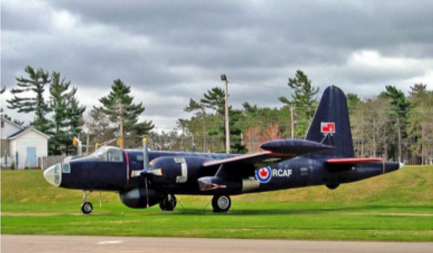
The U.S. Navy's last operational Neptune flew into CFB Greenwood,N.S. 27 August 1980, graciously donated to "The Association for the Preservation of Land Based Maritime Aircraft," incorporated 15 May 1980 to accept the aircraft, as government to government donations of war planes to RCAF
Aircraft Specifications
Roles: Maritime Reconnaissance/Patrol
Overall Length: 91 feet, 8 inches (28 metres)
Wing Span: 101 feet, 4 inches (40 metres)
Height (tip of tail): 29 feet, 4 inches (9 metres)
Empty Weight: 50,000 pounds (22,680 kilograms)
Maximum Weight: 72,000 pounds (32,659 kilograms) without jets; 80,000 pounds (36,287 kilograms) with jets
Maximum Speed: 449 miles per hour (390 Kts or 722 kilometres per hour)
Patrol (Cruising) Speed: 196 miles per hour (170 Kts or 315 kilometres per hour)
Engines: Two Wright Cyclone R-3350 18 cylinder turbo-compound radial engines of 3,400 hp (2,535 kw) with water injection, turning four-bladed Hamilton Standard propellers and, after 1959, two Westinghouse J34-WE36 turbojets of 3,400 pounds static thrust each
Range and Endurance: 2,000 miles (3,219 kilometers) and a 12 hour endurance
Fuel Load: 33,840 pounds (4,700 gallons) of 115/145 AVGAS for both the piston engines and the turbojets. Tip tanks were standard with 200 US gallons (757 Litres)
Crew: 2 pilots and a flight engineer, with standard tactical crew 10
ASW Equipment: APS-20 Radar, Electronic Support Measures (ESM), Exhaust Trail Indicator (ETI), searchlight, Magnetic Anomaly Detector (MAD), passive acoustics, Jezebel (low frequency sound detection and classification) and Julie (explosive echo ranging)
Searchlight: 70 million candlepower
Weapons: Torpedoes, bombs, depth charges, mines, rockets
Total built P2V7 only: 359/25 for RCAF
Cost: $1,284,400 each