
Group Captain E.L. Baudoux, DSO, DFC, CD
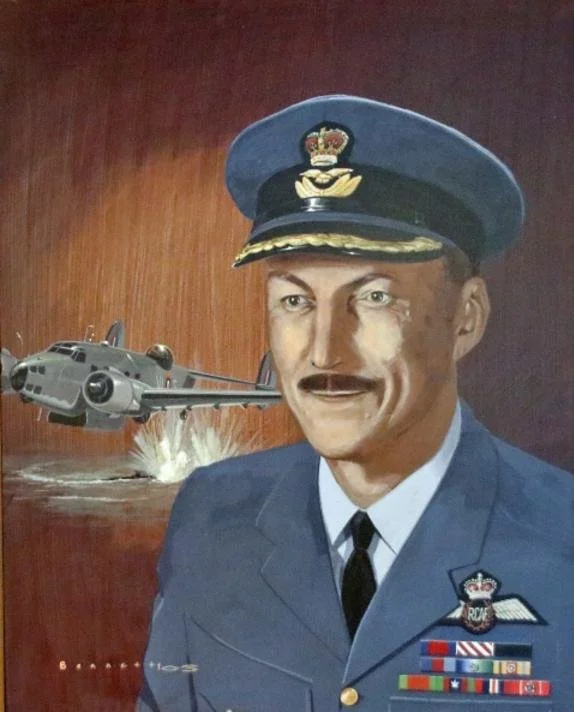
“Shan” Baudoux was born in Stellarton, Nova Scotia and gained his education there. He joined the Royal Air Force in October 1939 and following his training he began flying coastal operations with 233 Squadron based at RAF Leuchars, Scotland.
The Hudson aircraft portrayed in the background relates to an early mission where he was leading a “battle flight” of two other Hudsons on a North Sea patrol. They were armed with semi-armour piercing bombs with orders to attack targets of opportunity. All went well on the initial leg of the patrol and five miles short of the Norwegian coast they turned south maintaining a patrol altitude of 5,000 feet while scanning both visually and with their ASV radar for surface vessels. West of Stavanger they spotted a fully surfaced submarine. They began their attack while the other two Hudsons provided top cover against a possible threat by ME-110 or ME-109 enemy aircraft and also provided a capability for a second attack if required.
On this particular patrol Baudoux was acting as Navigator – there was a shortage of them at the time – and moved to the nose of the aircraft where he set the bombing computer for release by the pilot of four bombs at fifty foot intervals. Rather than dive as expected, the submarine used its deck gun and fired on the aircraft achieving a number of hits just as the bombs were released. The aircraft was barely controllable as the elevators were inoperable and flap was used to gain some altitude. The aircraft was nursed home to Scotland. Abandoning the aircraft had been considered but, after experimenting with flaps and power, it was found that the aircraft could be controlled well enough to attempt a landing. They arrived safely back at Leuchars. Post war information confirmed the submarine was badly damaged from the attack but had not been sunk. Baudoux went on to complete more than 100 coastal missions that included several attacks on U-Boats as well as shadowing the battleship Scharnhorst. He also operated with the USAAF instructing crews on the use of the Liberator as an Anti-submarine aircraft. In 1944 he completed the Empire Test Pilots Course at RAF Boscombe Down.
In 1945 Baudoux transferred to the RCAF and served in many capacities including: time as the Commanding Officer (CO) of the Winter Experimental Establishment, as CO of the Central Experimental and Proving Establishment where he flew the “Flying Wing” as well as the first flight of the CF-100. Staff tours at Air Force Headquarters followed but he completed his career as CO of CFB Greenwood and retired in August 1968.
G/C Baudoux served with distinction for many years with noteworthy achievements in many fields including that of Maritime operations