
Colonel Ronald F. “Ruff” Johnson, OMM, CD
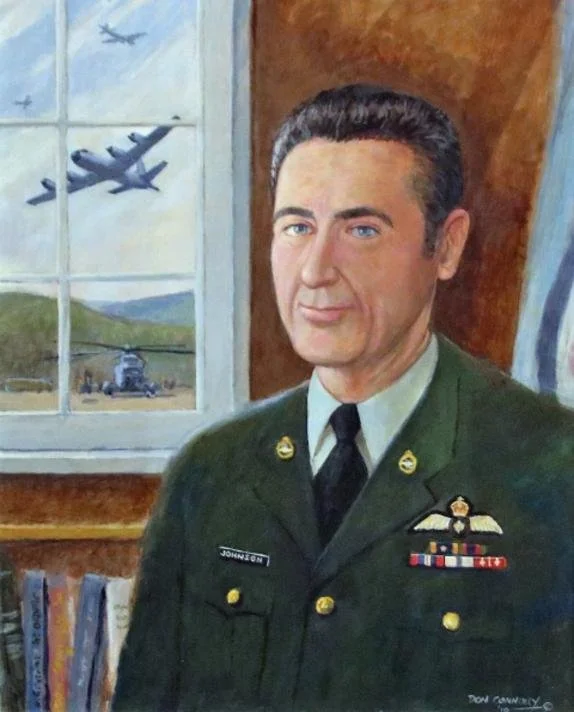
Ruff Johnson was born 5 February, 1926 in the mining town of Springhill, Nova Scotia. In 1944, eager to join in the wartime fray, he did successive stints in the RCAF and RN Fleet Air Arm. At war’s end, he resumed his education at St Francis Xavier University and TUNES (now Dalhousie) where he graduated with an engineering degree in 1949. While at university, he earned his pilot’s wings over three summers in the first post-war RCAF pilot training program. On graduation, he transferred to the permanent force element of the RCAF. On completion of the Maritime Operational Training Unit (OTU) he began operational flying on the venerable Lancaster, first on 405 Squadron and later on 404 Squadron. Missions were varied and challenging as were the training exercises with naval forces out of bases around the periphery of the Atlantic. October of 1952 saw a change in scenery for F/L Johnson on posting to the newly formed 407 Squadron at RCAF Station Comox. Again, the aircraft was the Lancaster and missions were largely surveillance in nature with frequent visits to US Naval air stations adding much interest.
In June of 1955, he began a series of ground tours including one at the RCAF Staff School followed by a year at the RAF Staff College in the UK. In 1966, he returned to flying duties after a third refresher at 2 (Maritime) OTU on Neptune aircraft preparatory to a second tour at 405 Squadron flying the Argus aircraft. At this time, the ASW role was very different: the nuclear submarine was the quarry and passive acoustics constituted the main search sensor. In August 1968, now a Lieutenant-Colonel, he was appointed Commanding Officer of 415 “Swordfish” Squadron at RCAF Station Summerside. Under his leadership, the 415 crews acquitted themselves well on all major exercises.
Next came a tour at Maritime Air Command HQ as Senior Staff Officer Operational Readiness Air for all squadrons: Argus, Sea King and Tracker. A most noteworthy achievement was the introduction of the Maritime Air Standardization Team (MAST); a formal standards and training program for all Maritime aircrew. For his success with this and other programs, he was inducted as an Officer in the Order of Military Merit.
A final career posting took him to the Directorate of Maritime Aviation at National Defence Headquarters in Ottawa. Selection of the Aurora to replace the Argus was a highlight. Another significant achievement was obtaining formal approval in 1979 to begin the Sea King replacement studies.
Col Johnson devoted 19 years of his RCAF career to Maritime aviation; his leadership and professional skills place him amongst the best of a thoroughly dedicated and professional group of Maritime aviators.