
Flight Lieutenant Edward Albert (Ted) De Long, CD
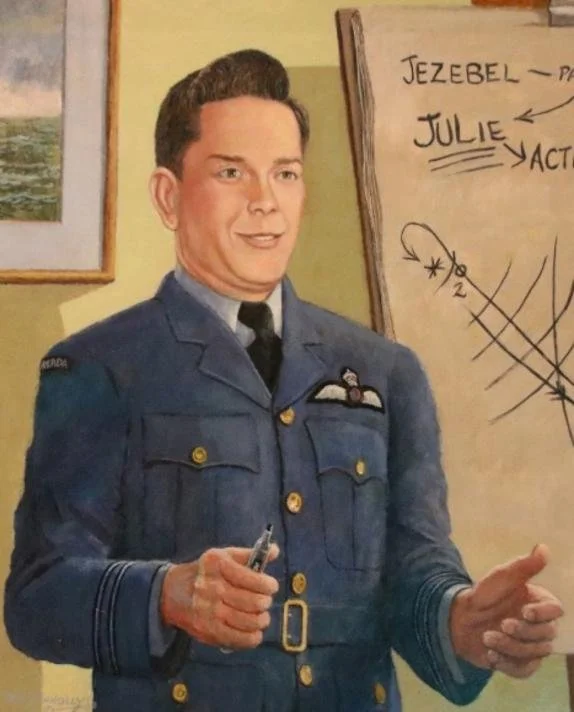
In late 1940’s the growing submarine fleet of the Soviet Union threatened the North Atlantic sealanes and Maritime Air Group was formed to supplement the RCN anti-submarine forces. No. 2 Operational Training Unit (OTU) and 405 Squadron and 404 Squadrons were activated with MK-X Lancasters taken from storage. They were inadequately equipped for their task; their main detection systems being basic sonobouys, an outdated and unreliable H2S Search Radar and a searchlight. New techniques and technology were needed. Into this scene came a young RCAF officer whose vision and determination was to make a difference.
“Ted” DeLong was born in West Lorne, Ontario in May 1928 and was educated there and at Royal Roads Military College before enlisting in the RCAF. He received his Navigator Wings at the Air Navigation School, Summerside, PEI in 1950. Following graduation from 2 (M) OTU he served with 405 Squadron, Greenwood until 1952 when he joined the Joint Maritime Warfare School (JMWS). During this tour he became particularly interested in the application of underwater acoustic methods to detect and track submerged submarines, whether snorkelling or operating on battery. He was requested to brief the annual Tripartite Sonobuoy Conference on his idea of tracking a submerged submarine by using a small explosive charge as the sound source to effectively make a passive sonobuoy active. His briefing attracted the attention of both US Navy officers and influential persons in industry. This led to “Project Julie” and eventual adoption of “Julie” as an operational tracking system.
Ted’s next position - 1954 to 1956 - was a new one at Maritime Air Command Headquarters (MACHQ) as Staff Officer Development and Evaluation (SOD&E). While with SOD&E, Ted’s reputation with the US Navy led to mutual discussions and with Bell Telephone Laboratories about long range submarine detection and identification employing passive acoustic methods. They resulted in equipment trials on a 404 Squadron Lancaster and the beginning of “Project Jezebel”. The use of the 404 Lancaster brought about the Test and Development Flight and eventually the Maritime Proving and Evaluation Unit (MP&EU).
Ted never saw the end results of these two major projects as a posting took him to Air Force Headquarters in 1956 for service in the Directorate of Operational Requirements. In 1960 Ted obtained his release from the RCAF and gained employment with industry in the field of Maritime equipment development.
Ted DeLong’s vision, his leadership skills and his dedication resulted in several outstanding contributions in the field of Anti-submarine warfare and this portrait is presented in recognition of those contributions.