
Flight Lieutenant Robert Morrison Aldwinckle, DFC
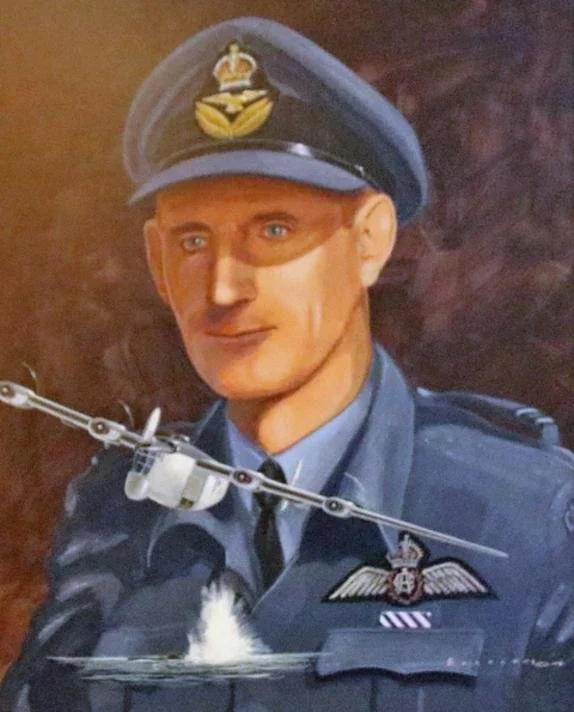
Robert Morrison Aldwinckle was born 28 July 1920 in England. He came to Canada as a child and had completed one year at the University of Toronto before joining the RCAF in August 1940. Awarded his pilots wings, he attended No. 13 Operational Training Unit (OTU) at Patricia Bay, BC training for duty with a Bomber Reconnaissance (BR) squadron. He began operations with 116 BR Squadron at Dartmouth on Catalina aircraft. Next came service with 10 BR Squadron Detachment in Yarmouth which shortly thereafter was renamed as 162 Squadron. While with 162 Squadron in Dartmouth he received a “Mention in Despatches”. In response to an urgent situation he went to Gander, Newfoundland in January 1943 flying Canso aircraft on Atlantic convoy protection patrols.
After converting to the B-24 Liberator in June he returned to 10 BR Squadron at Gander and resumed flying Atlantic patrols that now closed the “Atlantic Gap” - the U-Boat killing grounds during the period known as the “Happy Times”. On 26 October 1943 while patrolling in Liberator A586 Aldwinckle spotted a submarine on the surface and initiated a depth charge attack. The submarine saw the aircraft and began to dive and the attack weapon was changed to a “Zombie” – a top secret homing torpedo not to be used for surface attacks. The submarine then elected to remain surfaced and fight back with its two 20 MM anti-aircraft guns. The attack weapon was altered to a stick of six depth charges—but only one exploded. The submarine returned fire and Aldwinckle circled out of the guns range and attempted to get a second aircraft to the scene, but failed. A ruse of an open message declaring a return to base because of fuel shortage caused the submarine to dive at which time a second attack using the Zombie and two remaining depth charges was initiated. The attack appeared successful and was later confirmed—they had sunk U-420. During their return to base they attacked a second submarine with guns only and forced it to submerge. Flight Lieutenant (F/L) Aldwinckle was awarded the DFC for “his initiative and devotion to duty have at all times been exemplary”.
Subsequent duties saw F/L Aldwinckle promoted to Squadron Leader, posted to Eastern Air Command HQ and then to the Operations Staff at Air Force HQ where he was demobilized in May 1945.
He returned to the University of Toronto for one year but in 1946 he rejoined the RCAF and, while on leave-without-pay, he attended Oxford University as a Rhodes Scholar. He graduated with a degree in Engineering Science, and returned to full time RCAF service in the Aeronautical Engineering Branch until 1971 when he retired in the rank of Brigadier General. He had a second career working in several federal government departments. After full retirement Brigadier General Aldwinckle remained in Ottawa where he died in 2003.