
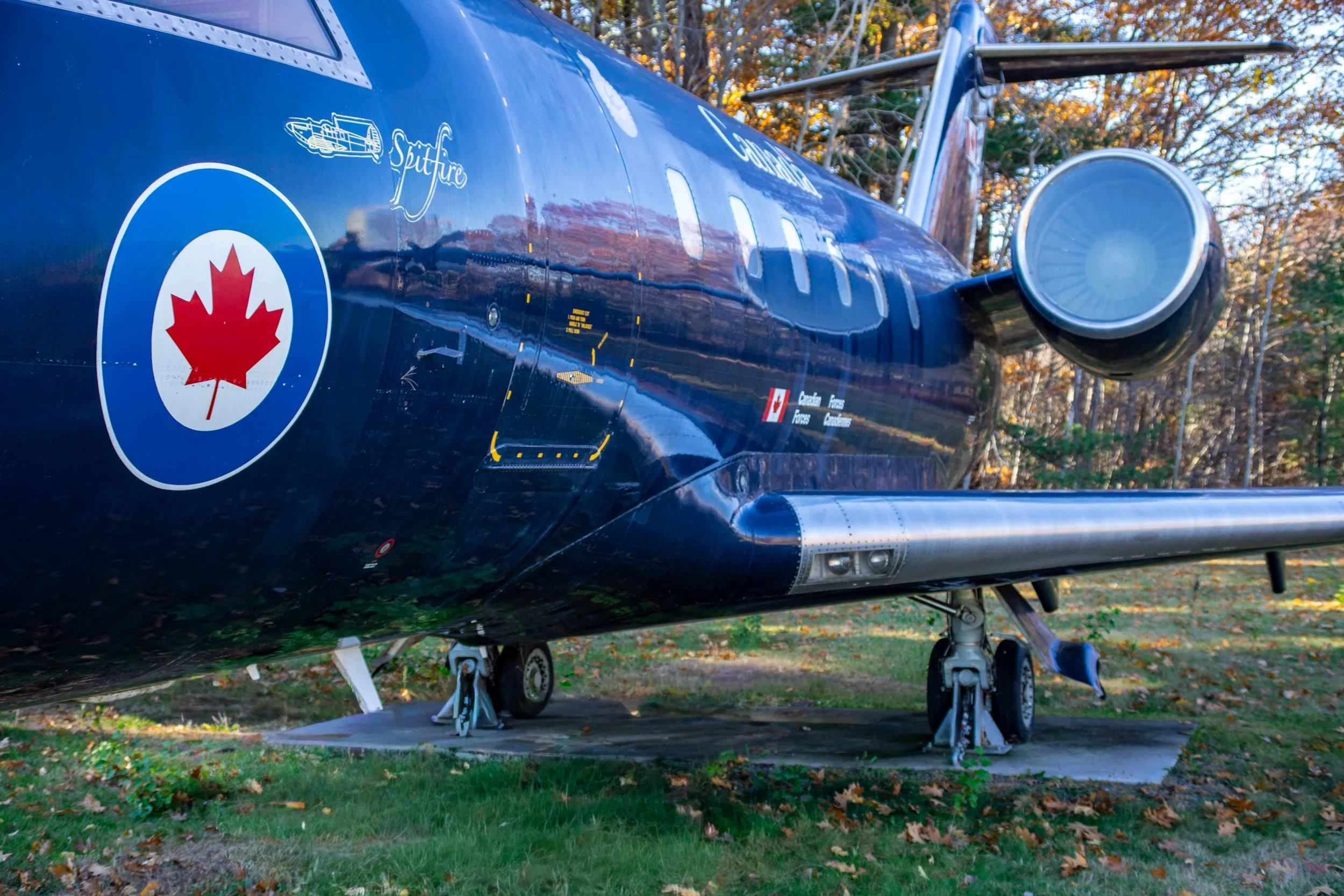
Candair Challenger
CC-144 / CE-114
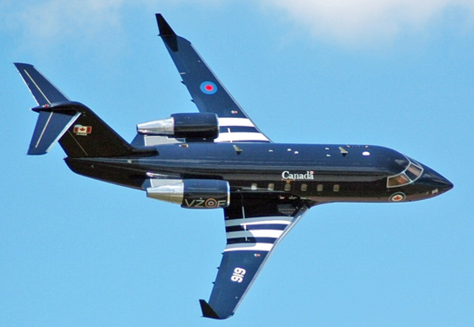
The Challenger was built by Canadair (Bombardier) of Montreal and certified as a business jet in 1980. The Canadian Forces Challenger fleet consisted of twelve 600-series aircraft procured from 1983-1988, four 601-series aircraft from 1986-1987 and two 604-series aircraft procured in 2002. Challengers were first employed in the VIP transport role at 412 Squadron in Ottawa. Later, in 1995, eleven Challengers were assigned to 434 Combat Support Squadron and one to Aerospace Engineering Test Establishment in Cold Lake, Alberta. In May 1995, 434 Squadron moved to CFB Greenwood with a mixed fleet of Challengers and T-33 Silver Stars. The versatility of the Challengers enabled the squadron to provide medical evacuation, costal patrol, diplomatic courier services, air target simulation and electronic warfare (EW) training for air force fighter squadrons, naval ship-borne air defence system operators, and army anti-aircraft battery operators. For many of these roles, a simple reconfiguration of the passenger compartment was all that was necessary, however major aircraft modifications were undertaken with four aircraft to develop a comprehensive EW suite.
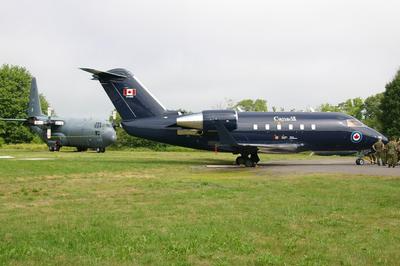
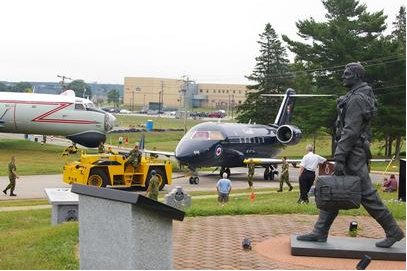
Aircraft tail number 603 with a partial EW suite flew as an interim electronic support trainer (IEST) while 606, 608, and 609 underwent extensive modifications. These three aircraft were to include a Tactical Coordination Officer station and a Communications station. The TACCO station included tactical moving map displays, an ESM (Electronic Support Measure) control and display, and an ECM (electronic countermeasures) control and display providing full EW capability. The suite was designed to provide fully integrated, simultaneous jamming of land, sea and air fire control radars, as well as the ability to deceive hostile radar with chaff.
The COMM station included a sophisticated ELINT (electronic intelligence gathering) capability, and communications jamming on HF and U/VHF radio frequencies, as well as voice record, edit and play back transmission capabilities to confuse adversaries.
Budget cuts led to the cancellation of the EST program before these highly modified Challengers took to the air. Electronic warfare training in the RCAF was eventually out-sourced to private industry, and in 2000, 434 EW Squadron was stood down. The majority of 434 Squadron Challengers were sold in 2001. 412 Squadron Challengers based in Ottawa continue to perform VIP transport duties flying 601 and 604 series aircraft. Our display aircraft is a 601 series aircraft with upgraded engines and a longer range than the 600 series aircraft flown from Greenwood. CC144616 was flown exclusively by 412 Squadron in a transport role and was retired from service in 2016. It will eventually be repainted to represent a 434 EW Squadron aircraft.
Click here to read more about the arrival of the Challenger into the museums exhibits.
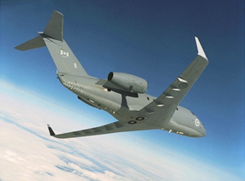
Challenger Flying
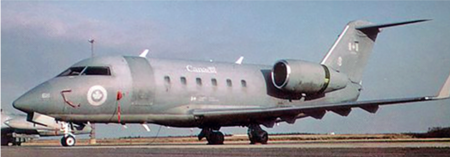
Challenger on runway
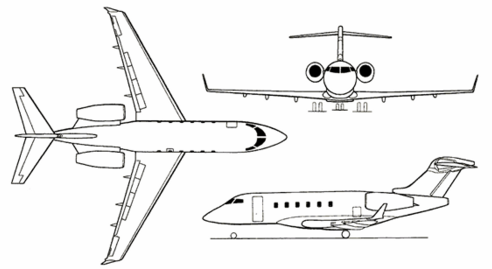
Challenger overview
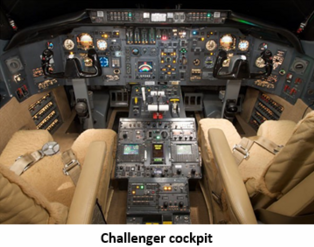
Challenger Cockpit
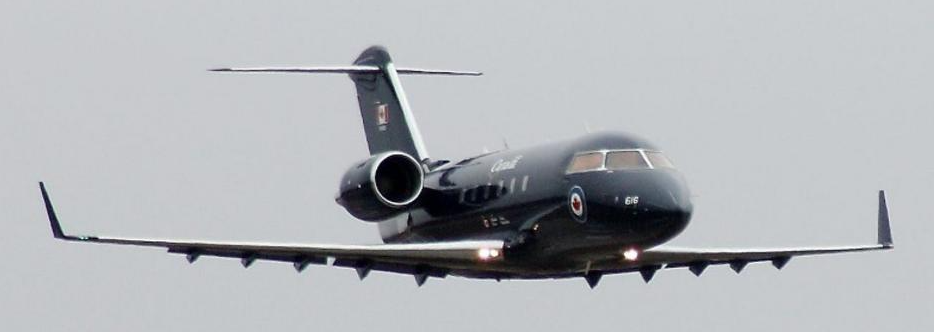
Challenger coming in for a landing
Aircraft Specifications
(600 Series)
Number built in Canada for the RCAF: 16 Challengers
Roles: Transport / MedEvac / Electronic Warfare / Costal Patrol
Manufacturer: Canadair / Bombardier Aerospace, St-Laurent, Quebec
Crew of two: Pilot, Co-Pilot
Powerplants: two 7,500 lb thrust Avco Lycoming ALF 502L turbofan engines
Max Cruising speed: 458 knots (848 kilometres per hour)
Service ceiling: 41,000 feet (12,500 metres)
Max Range: 3,220 miles (5,180 kilometres)
Empty weight: 31,000 pounds (14,060 kilograms)
Max Take Off Weight: 41,250 pounds (18,710 kilograms)
Wingspan: 61 feet 10 inches (18.85 metres)
Height: 20 feet 9 inches (6.32 metres)
Length: 68 feet 6 inches (20.88 metres)