A Uniform, a Name, and a Trail of Clues
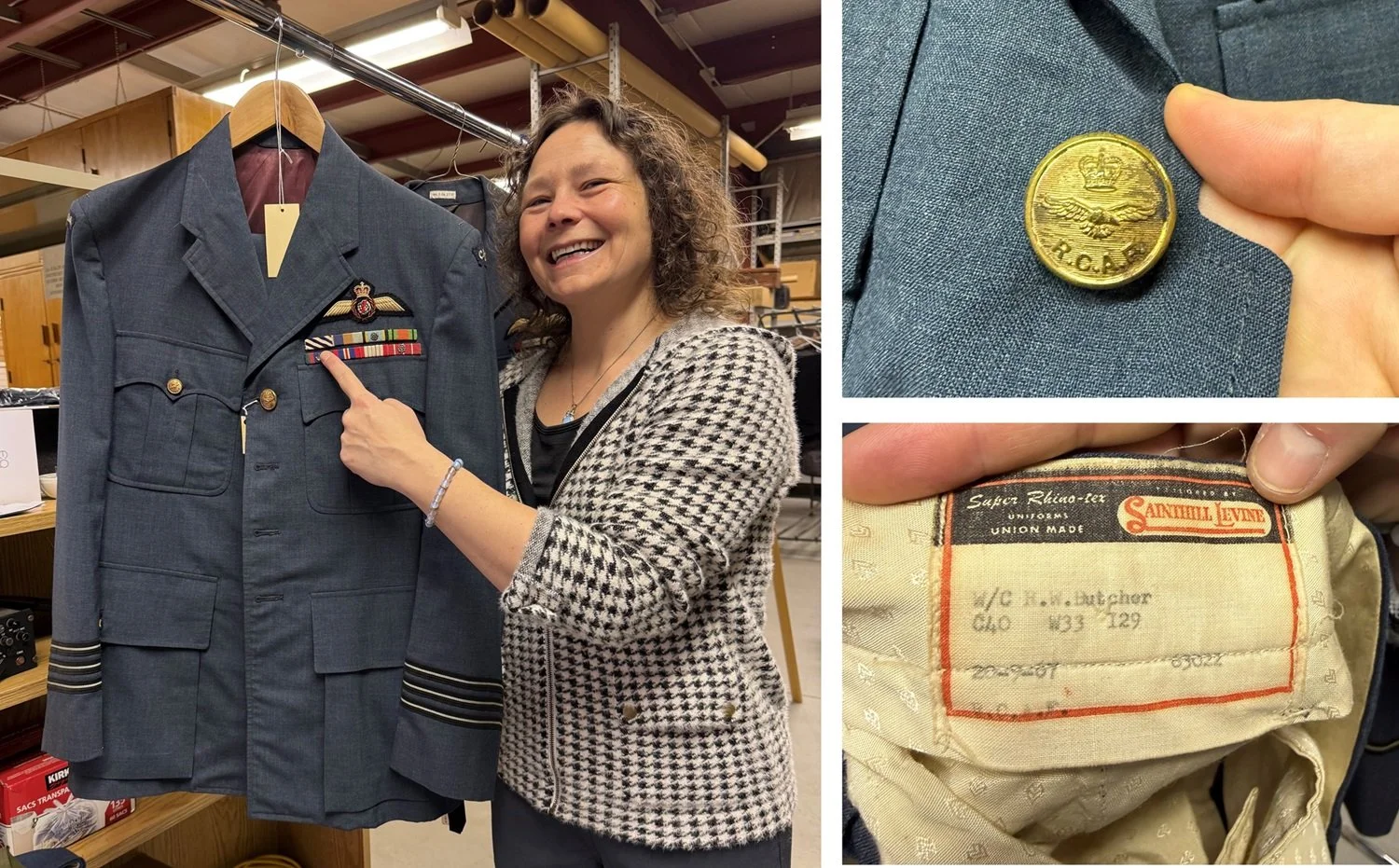
At first glance, it’s a blue uniform jacket and trousers on a hanger.
Look a little closer, and it becomes a detective story.
This uniform is part of the Greenwood Military Aviation Museum collection and belonged to Ronald (R.W.) Butcher, a Canadian officer from Sackville, New Brunswick. Like many artifacts in our care, it didn’t arrive with a complete biography neatly attached. Instead, it came with fragments—labels, tailoring marks, buttons, and a name—and it was up to the accessioning team to begin piecing the story together.
Inside the jacket are Canadian-made tailoring labels, confirming the uniform was manufactured in Canada, likely by a Canada Customs or Canadian military outfitter. During and after the Second World War, uniforms like this were produced domestically, reflecting Canada’s growing industrial capacity and its central role in the Allied war effort.
Small details matter. This Royal Canadian Air Force button bears the King’s (Tudor) Crown, not the Queen’s Crown adopted after 1953. That distinction places it squarely in the period between 1924 and 1952, after the Canadian Air Force became “Royal” but before the reign of Queen Elizabeth II. Something as simple as a button can narrow a uniform’s date by decades, anchoring it firmly in the interwar or Second World War era.
Pinned to the chest is a ribbon bar that includes the Distinguished Flying Cross, a decoration awarded for courage and devotion to duty while flying on active operations during the Second World War. That ribbon alone tells us the person who wore this uniform didn’t just serve—they flew, and they flew under combat conditions.
Inside the trousers, there are faint markings sewn into the inseam. At first glance, they raise questions—are these service numbers? Inventory codes? After closer examination, they are most likely tailoring or sizing marks, a common feature in custom or semi-custom uniforms. Not every mystery leads to a dramatic answer, but learning what isn’t something is just as important as learning what is.
Through careful research, including an obituary and service records, the accessioning team confirmed that Ronald Butcher served as a Wing Commander and flew with No. 408 Squadron, operating Lancaster bombers during the Second World War. While this particular uniform is not an RAF-issued wartime garment, the man who wore it was very much part of the air war over Europe.
Why This Matters at Greenwood
Greenwood was once a British Commonwealth Air Training Plan (BCATP) base, part of the vast training network that prepared aircrew for service overseas. Pilots, navigators, wireless operators, and air gunners passed through bases like Greenwood before joining operational squadrons.
Uniforms like this one help us connect those global events to individual lives. They remind us that the BCATP wasn’t just infrastructure—it was people.
What Is Accessioning—and Why Does It Matter?
Accessioning is the foundation of museum work. It’s the process of formally bringing an object into the collection, documenting it, researching it, assigning it a unique number, and preserving everything that can be known about it—before that knowledge is lost.
It’s part archival science, part historical research, and part detective work.
Accessioning also means revisiting assumptions. As new information comes to light, interpretations evolve. Good museum work isn’t about locking stories in place—it’s about refining them as evidence improves.
Why We Love This Work
Accessioning reminds us that history is personal.
Artifacts like this uniform were worn by real people, sewn by real tailors, and shaped by real-world events. Each label, button, and stitch is a clue—and following those clues is one of the most rewarding parts of museum work.
Sometimes we uncover definitive answers. Sometimes we narrow the field. And sometimes, we leave space for future discoveries.
If you have additional information about Ronald (R.W.) Butcher, No. 408 Squadron, or related service history, we would love to hear from you. Please contact the Greenwood Military Aviation Museum to help us continue the story.
Because history isn’t finished—it’s still being assembled.