Master Warrant Officer Steve Dornan
MWO Steve Dornan joined the Canadian military right out of high school as a 19-year-old Air Cadet-trained pilot. After five years in the Air Reserve in Summerside, the trained airborne electronic sensor operator (AESOp, in today’s designation) joined the Regular Force. He served as a trade instructor, the only Master Corporal working in the CP121 field, and as a flight instructor, before being sent to Comox and the CP140 Aurora. It was here he had his first solid introduction to the value of linking officers above and NCMs below, as 407 Squadron deployed to the Adriatic Sea to enforce the United Nations’ embargo on Yugoslavia. As the lead radar operator and non-acoustic sensor analyst, and the senior electronic warfare and surface-to-air missile threat analyst, he was a go-between for information, decision-making and action. In the mid-1990s, Dornan worked in intelligence in Winnipeg as a field analyst.
“Pulling all the data together was neat,” he says, of reports coming in from Italy, Haiti, Rwanda, Serbia and other international hot spots. He wrote the Canadian Air Defence threat estimate for the CF18 deployment over the former Yugoslavia, and then did two on-the-ground deployments in Bosnia. “An amazing opportunity, for sure,” he says, “working with different countries’ air crews and ground crews and passing on all the information of different radars and snipers targeting UN aircraft.”
Making connections between French ground forces, the Foreign Legion, United Kingdom Special Forces, Latvian and American air crews; relief and medical teams headed to Sarajevo, the British Army and other partners, he was NATO’s radar expert, an inspector, watcher and planner for training, targeting and inspecting throughout the region.
MWO Dornan first arrived at 14 Wing in 1997, and quickly became a lead sensor expert in change aboard the CP140, around radar, what is today’s Deployable Mission Support Centre for remote information gathering and camera technology. He used his experience working with air and ground crews to put together technology that was useful in the Aurora’s ISR role. Some of those changes were used during Op Mobile, the 2011 UN intervention over Libya, showcasing the Aurora’s new capabilities in overland surveillance.
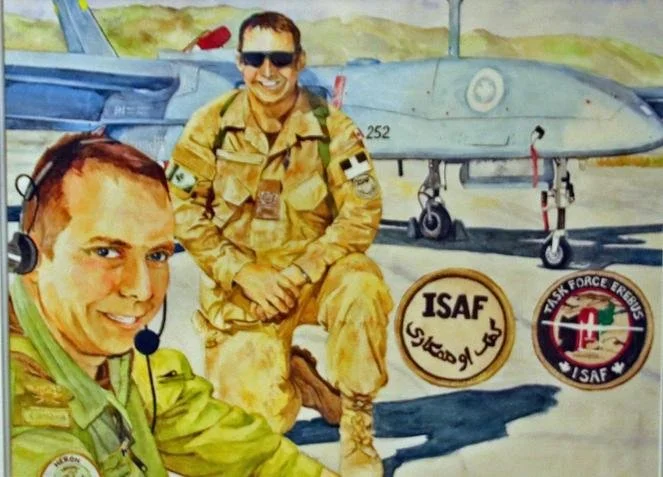
As early as 1995 in Bosnia-Herzegovina, MWO Dornan became the Canadian Armed Force’s senior unmanned aerial vehicle (UAV) sensor operator, and staffed recommendations on a future UAV detachment. He researched, priced, oversaw contracting and supply, tested, operated, developed policy, taught the use – and developed flight safety policy after crashes in testing and in the field in Afghanistan - of a half dozen UAV models over 10 years.“How we’re going to do it, use UAVs, the job descriptions around the equipment, the integration of UAVs and information into operations on a battlefield – in six months,” he said, of the 2007 introduction of UAVs in Canada’s Afghanistan presence. “We became the most critical air asset in theatre, and Greenwood was the monitoring unit: we put it together and integrated it with Army operations.”
In 2010, MWO Dornan retired from the forces: Canada was finishing Afghanistan field operations, he had 27 years in his career and he felt he was leaving “all the UAV lessons learned in place. “The paperwork was done, a lot of what was learned is now being applied in the Auroras. The AESOps today are where I was then, and I was happy.”