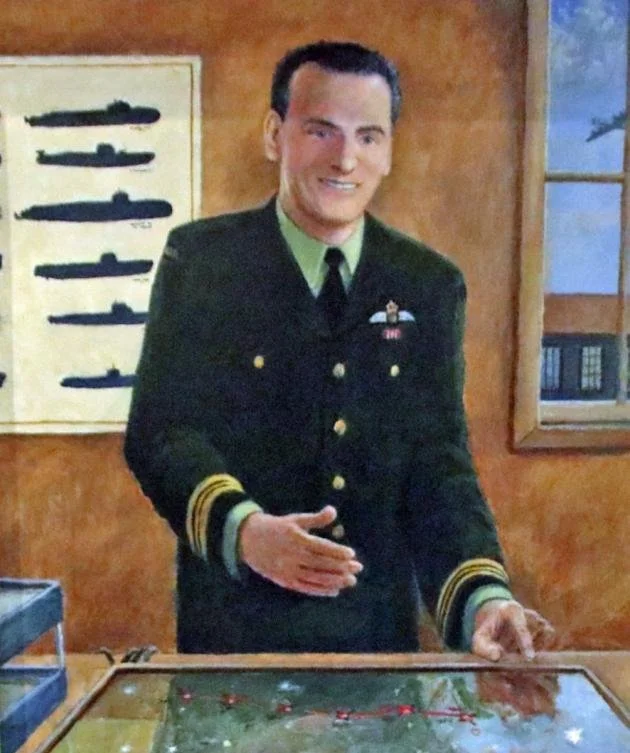
MAJOR HERBERT W. PARKER, CD, MBA
Herb was born in Georgetown, PEI May 29, 1927. He completed High School in nearby Montague and in January 1948 he joined the RCAF and was trained as an Aero-Engine Technician. In 1960, Herb was selected for Navigator training and in 1951 he was presented his wings by the Commander of the Italian Air Force.
Herb joined 404 Squadron in Greenwood and on completion of his tour he returned to No. 2 (M) OTU as a navigation and weapons instructor. Next, Herb joined the Maritime Proving and Evaluation Unit (MP&EU) where one of the many projects he conducted was the MK 43 Shallow Water Trial conducted in the Strait of Juan de Fuca, BC. The MP&EU received a commendation for the quality and content of the report.
On April 15, 1963 Herb was posted to Maritime Command Headquarters as the Staff Officer Development and Evaluation (SOD&E) and served as project officer for the “Nutmeg” Study and the development of the Moored Buoy Concept. His primary responsibilities included planning, organizing, coordinating, assessing and reporting on system performance. He wrote the Operation Order, the Test Plan and the Target Instructions for the Project Ocean IV, Phase II Operational Evaluation. Shortly thereafter, the 56 trial buoys were moored in 12,000 feet of water spaced 20 miles apart in the trial location South East of Sable Island. The field covered an area of approximately 25,000 square miles, roughly the size of the province of New Brunswick. Aircraft surveillance of the buoy field began July 20, 1966 and ended September 30 that year; a total of 73 trial days. The main objectives of the “Nutmeg” project were realized: the operational evaluation of the moored Buoy System demonstrated a remarkable performance throughout the trial. All five target submarines were detected and some of them were tracked in real time. The trial results were compiled in a 500-page report by Herb and the analysis team. The trial results were classified material and the decision not to proceed further with this concept was never made public.
Herb’s next posting took him to National Defence Headquarters and a position in the personnel branch as the Career Manager for 1400 Navigators and Radio Officers. His next move in 1971 was internal as he became the Director of Administrative Services for the Personnel Group where a major contribution was managing the conversion of the paper files to microfiche for all members of the Canadian Forces.
Herb retired in 1974. Major Herb Parker contributed much to the development of Anti-Submarine Warfare at a time when Canada was a major contributor in that field