A LAST ARGUS FLIGHT IN 10723
The Lockheed Hudson was derived from the Lockheed 14 Super Electra transport. The Hudson first flew in December, 1938 and entered squadron service with the RAF in February, 1939 as a General Reconnaissance (GR) aircraft and Navigation Trainer. A total of 2,584 aircraft were
produced and it was flown by many nations in various versions; from MK I to MK VI and also as the A-28, A:-28A, A-28B, A-29, A-29A, A-29B, AT-18 and AT-18A. One version was as a rescue aircraft carrying a life boat that was dropped to crews who had been forced to ditch their aircraft. It served in most combat theatres during WW II.
The Hudson aircraft assigned to No. 36 Operational Training Unit at Greenwood were MK III aircraft. On 11 May, 1942 the first 20 students commenced training. Student crews of pilots, navigators and gunners formed prior to flying training made up of advanced flying, navigation training, night searchlight sorties and submarine bombing and gunnery. Some aircraft were fully armed for training of both bombing and gunnery while others were unarmed aircraft for pilot and navigation training. The MK III had a wingspan of 65 feet 6 inches, a length of 44 feet 4 inches and a height of 11 feet 10 1/2 inches. It had an all-up weight of 18,500 lbs. It was powered by two 1,200 horsepower engines giving it a maximum speed of 246 miles per hour, a service ceiling of 24,500 feet and a range of 1,960 miles. When armed it had seven 0.303 Browning machines guns and an internal bomb load of 750 lbs of bombs or depth charges.
At one point there were 64 Hudsons serving at Greenwood in the training role but also doing operational patrols in the Bay of Fundy. Beginning in 1942 Greenwood was converting to a Mosquito OTU and when the first "Mossie" arrived in March 1943, the Hudsons were reduced in strength until by June there were only 21 left on strength. On 3 October, 1943 the last Hudson was struck off strength at Greenwood.
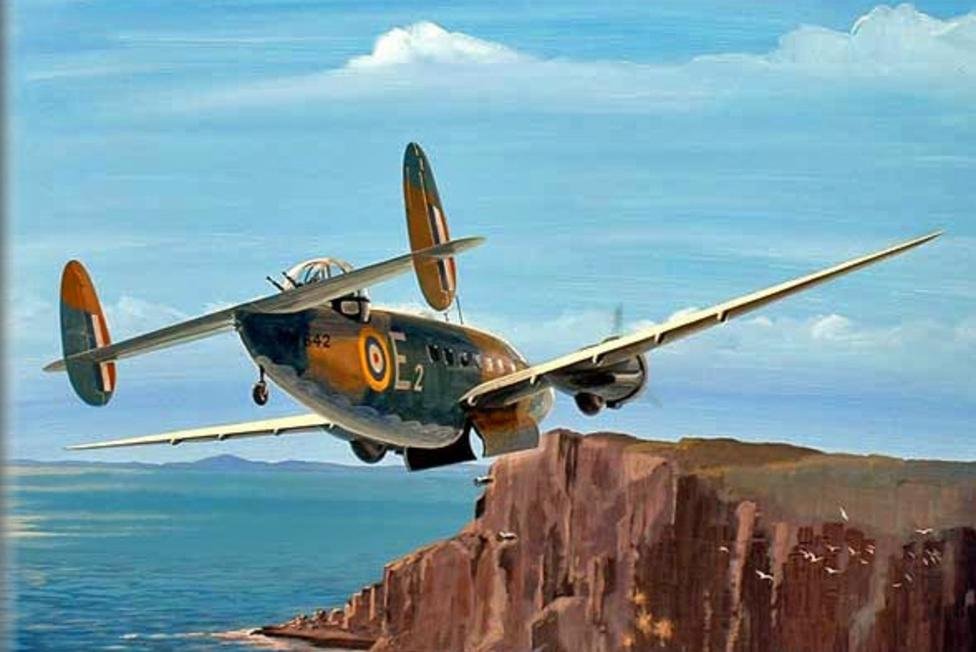
The painting shows Hudson BW 642 attacking "Ile Haute" which was a tactic taught at 36 OTU for use in the anti-shipping role the Hudson was often employed in while operating out of the UK. One RCAF squadron within Coastal Command and so employed was 407 (GR) "Demon"
Squadron. Indeed, personnel who having completed a tour of operations with 407 overseas were returned to Canada to be instructors at No. 36 OTU.
The concept for this painting came from a 1942 student of 36 OTU, Sergeant (later F/L) D. M. (Smoky) McLennan who described the tactic as one being taught by the returning 407 Squadron aircrew instructors