LCol Brendan Cook MSM, CD.
Operation IMPACT
Operation SHARP GUARD was a multi-year joint naval blockade in the Adriatic Sea by NATO and the Western European Union of illegal ship-borne movements to the former Yugoslavia. Warships and maritime patrol aircraft from 14 countries were involved in searching for and stopping blockade runners to enforce economic sanctions and an arms embargo. The operation replaced naval blockades Operation Maritime Guard (of NATO and begun by the U.S. in November 1992) and Sharp Fence (of the WEU). It put them under a single chain of command and control (the "Adriatic Military Committee", over which the NATO and WEU Councils exerted joint control), to address what their respective Councils viewed as wasteful duplication of effort. Some maintain that despite the nominal official joint command and control of the operation, in reality, it was NATO staff that conducted the operation. Begun 15 June 1993, the mission was suspended 19 June 1996 and terminated 02 October 1996.
The fourteen nations contributed ships, submarines and patrol aircraft: Belgium, Canada, Denmark, France, Germany, Greece, Italy, the Netherlands, Norway, Portugal, Spain, Turkey, the U.K., and the U.S. The operational area was divided into a series of "sea boxes", each the responsibility of a single warship. Each boarding team was composed of a "guard team" to board and wrest control of the target ship, and a "search team" to conduct the search. Coalition ships were authorized to board, inspect, and seize both ships seeking to break the blockade and their cargo. This operation marked the first time since its founding in 1949 that NATO was involved in combat operations. NATO and WEU forces challenged more than 73,000 ships, boarded and inspected almost 6,000 at sea, and diverted 1,500 suspect ships to ports for further inspection. Of those, nearly a dozen vessels were found to be blockade runners, some carrying arms in violation of UN Security Council resolutions. NATO officials said no ships were able to run the blockade successfully, and that the maritime blockade had a major effect in preventing escalation of the conflict.
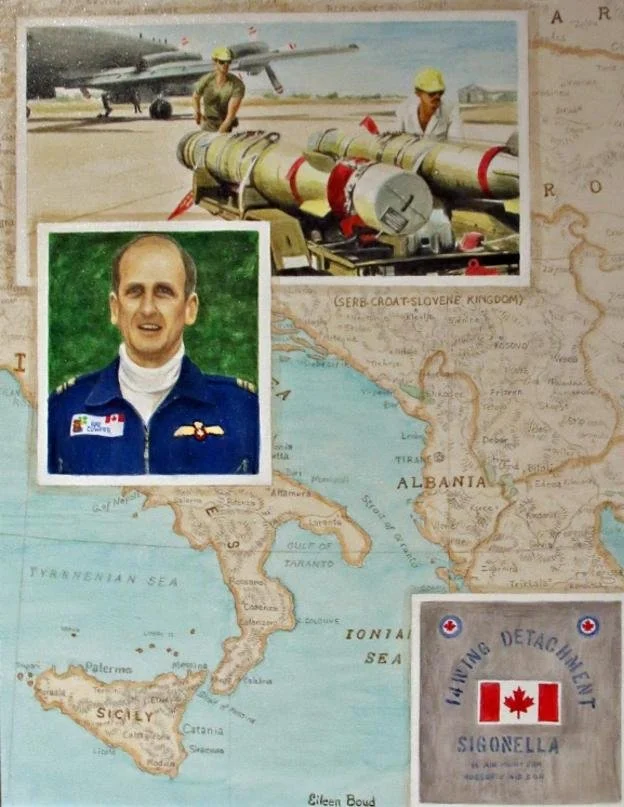
Canada provided naval and air forces. Greenwood and Comox provided Maritime Patrol aircraft and crews, with the first two aircraft, flight and maintenance crews, a small headquarters and live torpedoes arrived in NAS Sigonella, Sicily 28 Aug 93. This was the first operation for the Aurora aircraft where torpedoes were carried with rules of engagement for possible use. Aurora missions were long and arduous, providing valuable reconnaissance of water areas locating possible target ships for naval blockade investigation.
The portrait here is of the first detachment commander, Major Ray Cowper, whose personnel had the difficult task of setting up in a very congested, busy station far from home and operating armed patrols in a very dangerous mission. Hundreds of personnel followed this first detachment until mission conclusion.
This painting was commissioned and presented to the Museum by the Greenwood Art Association 28 April 2016; the artist is Eileen Boyd.